GIU Essential (Determiners and Pronouns 074-084)
Unit 074. this/that/these/those
A
- this (singular)
- Do you like this picture??
- (this picture here)
- these (plural)
- These flowers are for you.
- (these flowers here)
- that (singular)
- Do you like that picture?
- (that picture there)
- those (plural)
- Who are those people?
- (those people there)
B
We use this/that/these/those with a noun or without a noun:
- This hotel is expensive, but it’s very nice.
- Who’s that girl?
- I don’t know.
- Do you like these shoes? I bought them last week.
- Those apples look nice. Can I have one?
- This is a nice hotel, but it’s very expensive.
- Excuse me, is this your bag?
- Oh yes, thank you.
- Who’s that? (= Who is that person?)
- Which shoes do you prefer? these or those?
C
that = something that has happened:
- I’m sorry I forgot to phone you.
- That’s all right.
- That was a really nice meal. Thank you very much.
that = what somebody has just said:
- You’re a teacher, aren’t you?
- Yes, that’s right.
- Martin has got a new job.
- Has he? I didn’t know that.
- I’m going on holiday next week.
- Oh, that’s nice.
D
We use this is … and is that … ? on the telephone:
- Hi Sarah, this is David. (this = the speaker)
- Is that Sarah? (that = the other person)
We use this is … to introduce people:
- Brian, this is Chris.
Exercise
- Do you like these shoes?
- Who lives in that house?
- How much are these postcards?
- Look at those birds.
- Excuse me, is this seat free?
These plates are dirty.
- Is this your bag?
- Is that your umbrella?
- Is this your book?
- Are those your books?
- Is that your bicycle?
- Are these your keys?
- Are those your keys?
- Is this your watch?
- Are those your glasses?
Are these your gloves?
- I’m sorry I’m late.
- That’s all right.
- I can’t come to the party tomorrow.
- Oh, that’s a pity. Why not?
- Hello, Jane. This is Sue.
- Oh, hi Sue. How are you?
- You’re lazy.
- That’s not true!
- Beth plays the piano very well.
- Does she? I didn’t know that.
- Mark, this is my sister, Helen.
- Hi, Helen.
- I’m sorry I was angry yesterday.
- That’s OK. Forget it!
- You’re a friend of Tim’s, aren’t you?
- Yes, that’s right.
Unit 075. one/ones
A
one (= a …)
- These chocolates are good. Would you like one?
- (= Would you like a chocolate?)
- I need a pen. Have you got one? (one = a pen)
- Is there a bank near hear?
- Yes, there’s one at the end of the street.
B
one (singular)
this one / that one
- Which car is yours? This one or that one?
the one …
- Which hotel did you stay at?
- The one opposite the station.
- I found this key. Is it the one you lost?
the … one
- I don’t like the black coat, but I like the brown one.
- Don’t buy that camera. Buy the other one.
a/an … one
- This cup is dirty. Can I have a clean one?
- That biscuit was nice. I’m going to have another one.
one (plural)
these/those or these ones / those ones
- Which flowers do you want? These or those?
- These ones or those ones?
the ones …
- Which books are yours?
- The ones on the table.
- I found these keys. Are they the ones you lost?
the … ones
- I don’t like the red shoes, but I like the green ones.
- Don’t buy those apples. Buy the other ones.
some … ones
- These cups are dirty. Can we have some clean ones?
- My shoes are very old. I’m going to buy some new ones.
Exercise
- Can you lend me a pen?
- I’m sorry, I haven’t got one.
- Would you like to have a car?
- No, I don’t need one.
- Have you got a bike?
- No, but I’m going to get one.
- Can you lend me an umbrella?
- I’m sorry, but I haven’t got one.
- Would you like a cup of coffee?
- No, thank you. I’ve just had one.
- Is there a chemist near here?
- Yes, there’s one in Mill Road.
- This cup is dirty. Can I have a clean one?
- I’m going to sell my car and buy new one.
- That’s not a very good photograph, but this is better one.
- I want today’s newspaper. This is old one.
- This box is too small. I need big one.
Why do we always go to the same restaurant? Let’s go to different one.
- We stayed at a hotel.
- Which one?
The one opposite the station.
- I like those shoes.
- Which ones?
The green ones.
- That’s nice house.
- Which one?
The one with the red door.
- Are those your CDs?
- Which ones?
The ones on the top shelf.
- Do you like that jacket?
- Which one?
The black one.
- That’s an interesting picture.
- Which one?
The one on the wall.
- Do you know that girl?
- Which one?
The tall one with long hair.
- Those flowers are beautiful.
- Which ones?
The yellow ones.
- Who’s that man?
- Which one?
The one with a moustache and glasses.
- Did I show you my photos?
- Which ones?
- The ones I took at the party last week.
Unit 076. some and any
A
Use some in positive sentences:
- I’ve got some money.
- I’m going to buy some clothes.
- There’s some ice in the fridge.
- We made some mistakes.
Use any in negative sentences:
- I’m not going to buy any clothes.
- There isn’t any milk in the fridge.
- We didn’t make any mistakes.
B
any and some in questions
In most questions (but not all) we use any (not some):
- Is there any ice in the fridge?
- Has he got any friends?
- Do you need any help?
We normally use some (not any) when we offer things (Would you like …?):
- Would you like some coffee?
- Yes, please.
or when we ask for things (Can I have …? etc.):
- Can I have some soup, please?
- Yes, Help yourself.
- Can you lend me some money?
- Sure. How much do you need?
C
some and any without a noun
- I didn’t take any photographs, but Jane took some.
- You can have some coffee, but I don’t want any.
- I’ve just made some coffee. Would you like some?
- Where’s your luggage?
- I haven’t got any.
- Are there any biscuits?
- Yes, there are some in the kitchen.
D
something / somebody (or someone)
- She said something.
- I saw somebody (or someone).
- Would you like something to eat?
- Somebody’s at the door.
anything / anybody (or anyone)
- She didn’t say anything.
- I didn’t see anybody. (or anyone)
- Are you doing anything tonight?
- Where’s Sue? Has anybody seen her?
Exercise
- I bought some cheese, but I didn’y buy any bread.
- I’m going to the post office. I need some stamps.
- There aren’t any shops in this part of town.
- Gary and Alice haven’t got any children.
- Have you got any brothers or sisters?
- There are some beautiful flowers in the garden.
- Do you know any good hotels in London?
- Would you like some tea?
- Yes, please.
- When we were on holiday, we visited some very interesting places.
- Don’t buy any rice. We don’t need any.
- I went out to buy some oranges, buy they didn’t have any in the shop.
I’m thirsty. Can I have some water, please?
- I want to wash my hair. Is there any shampoo?
- The police want to talk to you. They want to ask you some questions.
- I haven’t got my camera, so I can’t take any photographs.
- Do you speak any foreign languages?
- Yesterday evening I went to a restaurant with some friends of mine.
- Can I have some milk in my coffee, please?
- The radio isn’t working. There aren’t any batteries in it.
- It’s hot in this office. I’m going out for some fresh air.
- Would you like some cheese?
- No, thank you. I’ve had enough to eat.
I can do this job alone. I don’t need any help.
- Jane didn’t take any photographs, but I took some.
- Where’s your luggage?
- I haven’t got any.
- Do you need any money?
- No, thank you. I have some.
- Can you lend me some money?
- I’m sorry, but I haven’t got any.
- The tomatoes in the shop didn’t look very good, so I didn’t buy any.
- There were some nice oranges in the shop, so I bought some.
- How many phone calls did you make yesterday?
- I didn’t make any.
- A woman stopped me and said something, but I didn’t understand.
- What’s wrong?
- There’s something in my eye.
- Do you know something about politics?
- I went to the shop, but I didn’t buy anything.
- Somebody has broken the window. I don’t know who.
- There isn’t anything in the bag. It’s empty.
- I’m looking for my keys. Has anybody seen them?
- Would you like something to drink?
- I didn’t eat anything because I wasn’t hungry.
- This is a secret. Please don’t tell anybody.
Unit 077. not + any no none
A
- The car park is empyty.
- There aren’t any cars in the car park.
- There are no cars in the car park.
- How many cars are there in the car park?
- None.
not (-n’t) + any
- There aren’t any cars in the car park.
- Tracey and Jeff haven’t got any children.
- You can have some coffee, but I don’t want any.
no … = not any or not a
- There are no cars in the car park.
- We’ve got no coffee.
- It’s nice house, but there’s no garden.
We use no … especially after have (got) and there is/are.
negative verb + any = positive verb + no
- They haven’t got any children.
- They’ve got no children.
- There isn’t any sugar in your coffee.
- There’s no sugar in your coffee.
B
no and none
Use no + noun
- We’ve got no money.
- Everything was OK. There were no problems.
Use non alone (without a noun)
- How much money have you got?
- None.
- Were there any problems?
- No, none.
C
none and no-one
None is an answer for How much? / How many? (things or people)
- How much money have you got?
- None.
- How many people did you meet?
- None.
No-one is an answer for Who?
- Who did you meet?
- No-one. or Nobody.
Exercise
- We haven’t got any money.
- We’ve got no money.
- There aren’t any shops near here.
- There are no shops near here.
- Carla hasn’t got any free time.
- Carla has no free time.
- There isn’t a light in this room.
- There is no light in this room.
- We’ve got no money.
- We haven’t got any money.
- There’s no milk in the fridge.
- There isn’t any milk in the fridge.
- There are no buses today.
- There aren’t any buses today.
- Tom has got no brothers or sisters.
- Tom hasn’t got any brothers or sisters.
- There’s no sugar in your coffee.
- My brother is married, but he hasn’t got any children.
- Sue doesn’t speak any foreign languages.
- I’m afraid there’s no coffee. Would you like some tea?
- Look at those birds!
- Birds? Where? I can’t see any birds.
- Do you know where Jessica is?
- No, I’ve got no idea.
- There aren’t any pictures on the wall.
- The weather was cold, but there was no wind.
- I wanted to buy some oranges, but they didn’t have any in the shop.
- Everything was correct. There were no mistakes.
- How much luggage have you got?
- None.
- How much luggage have you got?
- I haven’t got any.
- Everything was OK. There were no problems.
- Jack and Emily would like to go on holiday, but they’ve got no money.
- I’m not going to answer any questions.
- He’s always alone. He’s got no friends.
- There is no difference between these two machines. They’re exactly the same.
- There wasn’t no furniture in the room. It was completely empty.
- I tried to phone you yesterday, but there was no answer.
- The house is cold because there isn’t any heating.
- There was no queue outside the cinema, so we didn’t have to wait to get our tickets.
Unit 078. not + anybody/anyone/anything nobody/no-one/nothing
A
- There isn’t anybody(anyone) in the room.
- There is nobody(no-one) in the room.
- Who is in the room?
- Nobody. / No-one.
-body and -one are the same
- There isn’t anything in the bag.
- There is nothing in the bag.
- What’s in the bag?
- Nothing.
B
- I don’t know anybody (anyone)
- I’m lonely. I’ve got nobody to talk to.
- (= I haven’t got anybody)
- The house is empty. There is no-one.
- (= There isn’t anyone in it.)
- I can’t remember anything.
- She said nothing.
- She didn’t say anything.
- There’s nothing to eat.
- There isn’t anything to eat.
C
You can use nobody/no-one/nothing at the beginning of a sentence or alone:
- The house is empty. Nobody lives there.
- Who did you speak to?
- No-one.
- Nothing happened.
- What did you say?
- Nothing.
D
Remember:
- negative verb + anybody/anyone/anything
positive verb + nobody/no-one/nothing
- He doesn’t know anything.
- Don’t tell anybody.
- There is nothing to do in this town.
Exercise
- There isn’t anything in the bag.
- There’s nothing in the bag.
- There isn’t anybody in the office.
- There’s nobody in the office.
- I haven’t got anything to do.
- I’ve got nothing to do.
- There isn’t anything on TV.
- There’s nothing on TV.
- There wasn’t anyone at home.
- There was nobody at home.
- We didn’t find anything.
- We found nothing.
- There’s nothing in the bag.
- There isn’t anything in the bag.
- There was nobody on the bus.
- There wasn’t anybody on the bus.
- I’ve got nothing to read.
- I haven’t got anything to read.
- I’ve got no-one to help.
- I haven’t got anybody to help.
- She heard nothing.
- She didn’t hear anything.
- We’ve got nothing for dinner.
- We haven’t got anything for dinner.
- What did you say?
- Nothing.
- Who saw you?
- Nobody.
- What do you want?
- Nothing.
- Who did you meet?
- Nobody.
- Who knows the answer?
- Nobody.
- What did you buy?
- Nothing.
- What happened?
- Nothing.
- Who was late?
- Nobody.
- The house is empty. Nobody lives there.
- Jack has a bad memory. He can’t remember anything.
- Be quiet! Don’t say anything.
- I didn’t know about the meeting. Nobody told me.
- What did you have to eat?
- Nothing. I wasn’t hungry.
- I didn’t eat anything. I wasn’t hungry.
- Helen was sitting alone. She wasn’t with anybody.
- I’m afraid I can’t help you. There’s nothing I can do.
- I don’t know anything about car engines.
- The museum is free. It doesn’t cost anything to go in.
- I heard knock on the door, but when I opened it, there was nobody there.
- The hotel receptionist spoke very fast. I didn’t understand anything.
- What are you doing tonight?
- Nothing. Why?
- Helen has gone away. Nobody knows where she is. She didn’t tell anybody where shw was going.
Unit 079. somebody/anything/nowhere etc.
A
somebody/someone
- A person, but we don’t know who
- Somebody (or Someone) has broken the window.
something
- A thing, but we don’t know what
- She has got something in her mouth.
somewhere
- in/to a place, but we don’t know where
- Tom lives somewhere near London.
B
- There is somebody (or someone) at the door.
- Is there anybody (or anyone) at the door?
- There isn’t anybody (or anyone) at the door.
There is nobody (or no-one) at the door.
- Lucy said something, but I didn’t understand what she said.
- Are you doing anything at the weekend?
- I was angry, but I didn’t say anything.
- What did you say?
- Nothing.
- Ruth’s parents live somewhere in the south of England.
- Did you go anywhere interesting for your holidays?
- I’m staying here. I’m not going anywhere.
- I don’t like this town. There is nowhere to go.
C
- Did you meet anybody interesting at the party?
- We always go to the same place. Let’s go somewhere different.
- What’s that letter?
- It’s nothing important.
D
- I’m hungry. I want something to eat.
- Tony hasn’t got anybody to talk to.
- There is nowhere to go in this town.
Exercise
- Lucy said something.
- What did she say?
- I’ve lost something.
- What have you lost?
- Sue and Tom went somewhere.
- Where did they go?
- I’m going to phone somebody.
- Who are you going to phone?
- What did you say?
- Nothing.
- Where are you going?
- Nowhere.
- What do you want?
- Nothing.
- Who are you looking for?
- Nobody.
- I didn’t say anything.
- I’m not going anywhere.
- I don’t want anything.
I’m not looking for anybody.
- It’s dark. I can’t see anything.
- Tom lives somewhere near London.
- Do you know anything about computers?
- Listen!
- What? I can’t here anything.
- What are you doing here?
- I’m waiting for somebody.
- We need to talk. There’s something I want to tell you.
- Did anybody see the accident?
- No, nobody.
- We weren’t hungry, so we didn’t eat anything.
- What’s going to happen?
- I don’t know. Nobody knows.
- Do you know anyone in Paris?
- Yes, a few people.
- What’s in that cupboard?
- Nothing. It’s empty.
- I’m looking for my glasses. I can’t find them anywhere.
- I don’t like cold weather. I want to live somewhere warm.
- Is there anything interesting on television tonight?
Have you ever met anybody famous?
- We don’t go out very much because there’s where to go.
- There isn’t any food in the house. We haven’t got anything to eat.
- I’m bored. I’ve got nothing to do.
- Why are you standing?
- Because there isn’t anything to sit.
- Would you like something to drink?
- Yes, please - a glass of water.
- If you’re going to the city centre, take the bus. Don’t drive because there’s nowhere to park.
- I want something to read. I’m going to buy a magazine.
- I need somewhere to stay in London. Can you recommend a hotel?
Unit 080. every and all
A
We use every + singular noun (every house / every country etc.):
- Sarah has been to every country in Europe.
- Every summer we have a holiday by the sea.
- She looks different every time I see her.
Use a singular verb after every …:
- Every house in the street is the same.
- Every country has a national flag.
Compare every and all:
- Every student in the class passed the exam.
- All the students in the class passed the exam.
- Every country has a national flag.
- All the countries have a national flag.
B
every day and all day
every day = on all days:
- It rained every day last week.
- Bill watches TV for about two hours every evening. (= on all evenings)
all day = the complete day:
- It rained all day yesterday.
- On Monday, I watched TV all evening. (= the complete evening)
C
- Everybody needs friends.
- (= All people need friends)
- Have you got everything you need?
- (= All the things you need)
- I lost my watch. I’ve looked everywhere for it.
- (= I’ve looked in all places)
Exercise
- Every student in the class passed the exam.
- My job is very boring. Every day is the same.
- Kate is a very good tennis player. When we play, she wins every time.
- Every room in the hotel has satellite TV.
- Did you understand what she said?
- Most of it, but not every word.
- Yesterday it rained all day.
- I buy a newspaper every day, but sometimes I don’t read it.
- I’m not going out tomorrow. I’ll be at home all day.
- I usually drink about four cups of coffee every day.
- Paula was ill yesterday, so she stayed in bed all day.
- I’m tired now because I’ve been working hard all day.
Last year, we went to the seaside for a week, and it rained every day.
- Bill watches TV for about two hours every evening.
- Julia gets up at 6.30 every morning.
- The weather was nice yesterday, so we sat outside all afternoon.
- I’m going away on Monday. I’ll be away all week.
- How often do you go skiing?
- Every year. Usually in March.
- Were you at home at 10 o’clock yesterday?
- Yes, I was at home all morning. I went out after lunch.
- My sister loves new cars. She buys one every year.
- I saw Sam at the party, but he didn’t speak to me all evening.
We go away on holiday for two or three weeks every summer.
- Everybody nees friends.
- Chris knows everything about computers.
- I like the people here. Everybody is very friendly.
- This is a nice hotel. It’s comfortable and everything is very clean.
- Kevin never uses his car. He goes everywhere by motorcycle.
- Let’s get something to eat. Everybody is hungry.
- Sue’s house is full of books. There are books everywhere.
You are right. Everything you say is true.
- Everybody has problems.
- Are you ready yet? Everybody is waiting for you.
- The house is empty. Everyone has gone out.
- Gary is very popular. Everybody likes him.
- This town is completely different now. Everything has changed.
- I got home very late last night. I came in quietly because everyone was asleep.
- Everybody makes mistakes!
- Is everything clear? Does everybody know what to do?
- Yes, we all understand.
Unit 081. all most some any no/none
A
children/money/books etc. (in general):
- Children like playing. (= children in general)
- Money isn’t everything. (= money in general)
- I enjoy reading books.
- Everybody needs friends.
the children / the money / these books etc:
- Where are the children? (= our children)
- I want to buy a car, but I haven’t got the money. (= the money for a car)
- Have you read these books?
- I often go out with my friends.
B
most / most of …, some / some of … etc.
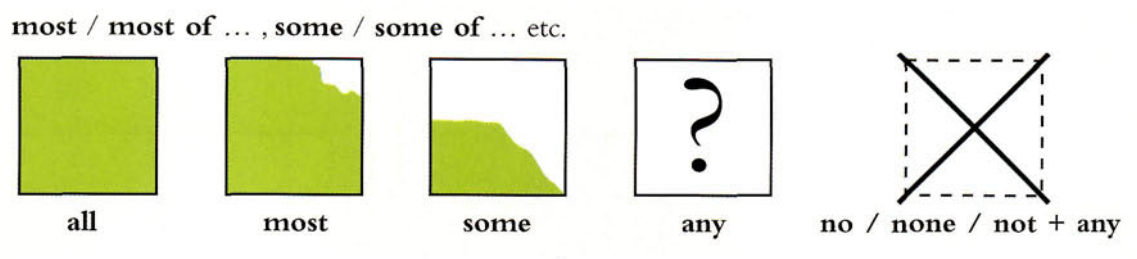
most/some etc. + noun
- Most children like playing. (= children in general)
- I don’t want any money.
- Some books are better than others.
- He’s got no friends.
- All cities have the same problems. (= cities in general)
Do not use of in these sentences:
- Most people drive too fast. (not Most of people)
- Some birds can’t fly. (not Some of birds)
most of / some of etc. + the/this/my … etc.
- Most of the children at this school are under 11 years old.
- I don’t want any of this money.
- Some of these books are very old.
- None of my friends live near me.
You can say all the … or all of the … (with or without of)
- All the students in our class passed the exam. (or All of the studens …)
- Silvia has lived in London all her life. (or all of her life.)
C
all of it / most of them / none of us etc.
- You can have some of this cake, but not all of it.
- Do you know those people?
- Most of them, but not all of them.
- Some of us are going out tonight. Why don’t you come with us?
- I’ve got a lot of books, but I haven’t read any of them.
- How many of these books have you read?
- None of them.
Exercise
- Most children like playing.
- Some of this money is yours.
- Some people never stop talking.
- Most of the shops in the city centre close at 6.30.
- You can change your money in most banks.
- I don’t like any of the pictures in the living room.
- He’s lost all his money.
- None of my friends are married.
- Do you know any of the poeple in this photograph?
- Most birds can fly.
- I enjoyed most of the film, but I didn’t like the ending.
- Some sports are very dangerous.
- We can’t find anywhere to stay. All the hotels are full.
- You must have some of this cheese. It’s delicious.
The weather was bad when we were on holiday. It rained most of the time.
- How many of the poeple are women?
- Most of them.
- How many of the boxes are on the table?
- All of them.
- How many of the men are wearing hats?
- Some of them.
- How many of the windows are open?
- None of them.
- How many of the people are standing?
- Most of them.
- How much of the money is Ben’s?
- None of it.
- Most children like playing.
- All the students failed the exam.
- Some people work too hard.
- Some of the questions in the exam were very easy.
- I haven’t seen any of those people before.
- All insects have six legs.
- Have you read all (of) these books?
- Most of the students in our class are very nice.
- Most of my friends are going to the party.
- I’m very tired this morning. I was awake most of the night.
Unit 082. both either neither
A
We use both/either/neither to talk about two things or people:
- Rebecca has two children. Both are married. (both = the two children)
- Would you like tea or coffee? You can have either. (either = tea or coffee)
- Do you want to go to the cinema or the theatre?
- Neither. I want to stay at home. (neither = not the cinema or the theatre)
Compare either and neither:
- Would you like tea or coffee?
- Either. I don’t mind. (= tea or coffee)
- I don’t want either. (not I don’t want neither)
- Neither. (= not tea or coffee)
B
both + plural / either or neither + singular
- Last year, I went to Paris and Rome. I liked both cities very much.
- First I worked in an office, and later in a shop. Neither job was very interesting.
- There are two ways from here to the station. You can go either way.
C
- Neither of my parents is British.
- I haven’t read either of these books.
You can say both of the/those/my … or both the/those/my … (with or without of):
- I like both of those pictures. or I like both those pictures.
- Both of Paul’s sisters are married. or Both Paul’s sisters are married.
- Neither of Paul’s sisters are married. (not Neither Paul’s sisters)
D
- Paul has got two sisters. Both of them are married.
- Sue and I didn’t eat anything. Neither of us was hungry.
- Who are those two people? I don’t know either of them.
Exercise
- Last year I went to Paris and Rome. I liked both cities very much.
- There were two pictures on the wall. I didn’t like either of them.
- I was a good football match. Both teams played well.
- It wasn’t a good football match. Neither team played well.
- Is your friend English or American?
- Neither. She’s Australian.
- We went away for two days, but the weather wasn’t good. It rained both days.
- I bought two newspapers. Which one do you want?
- Either. It doesn’t matter which one.
- I invited Donna and Mike to the party, but neither of them came.
- Do you go to work by car or by bus?
- Neither. I always walk.
- Which jacket do you prefer, this one or that one?
- I don’t like either of them.
- Do you work or are you a student?
- Both. I work and I’m a student too.
- Paula and I didn’t know the time because neither of us had a watch.
- Helen has got two sisters and a brother. Both sisters are married.
Helen has got two sisters and a brother. I’ve met her brother, but I haven’t met either of her sisters.
- Both cups are empty.
- Both windows are open.
- Neither of them (Neither man) is wearing a hat.
- Both men have beards.
- Both buses go to the airport.
Neither answer is right.
- Neither of them is married.
- Both of them are 21.
- Both of them are students.
- Neither of them has got a car.
- Both of them live in London.
- Both of them like cooking.
- Neither of them can play the piano.
- Both of them read newspapers.
- Neither of them is interested in sport.
Unit 083. a lot much many
A
We use much + uncountable noun (much food / much money etc.):
- Did you buy much food?
- We haven’t got much luggage.
- How much money do you want?
- Have you got any money?
- I’ve got some, but not much.
We use many + plural noun (many books / many people etc.):
- Did you buy many books?
- We don’t know many people.
- How many photos did you take?
- Did you take any photos?
- I took some, but not many.
We use a lot of + both types of noun:
- We bought a lot of food.
- Paula hasn’t got a lot of free time.
- We bought a lot of books.
- Did they ask a lot of questions?
We say:
- There is a lot of food/money/water … (singular verb)
- There are a lot of trees/shops/people (plural verb)
- A lot of people speak English. (not speaks)
B
We use much in questions and negative sentence:
- Do you drink much coffee?
- I don’t drink much coffee.
But we do not often use much in positive sentences:
- I drink a lot of coffee. (not I drink much coffee)
- Do you drink much coffee?
- Yes, a lot. (not Yes, much)
We use many and a lot of in all types of sentences (positive/negative/question):
- We’ve got many friends / a lot of friends.
- We haven’t got many friends / a lot of friends.
- Have you got many friends? / a lot of friends?
C
You can use much and a lot without a noun:
- Donna spoke to me, but she didn’t say much.
- Do you watch TV much?
- No, not much. (= not often)
- We like films, so we go to the cinema a lot. (not go to the cinema much)
- I don’t like him very much.
Exercise
- Did you buy much food?
- There aren’t many hotels in this town.
- We haven’t got much petrol. We need to stop and get some.
- Were there many people on the train?
- Did many students fail the exam?
- Paula hasn’t got much money.
- I wans’t hungry, so I didn’t eat much.
- I don’t know where Gary lives these days. I haven’t seen him for many years.
- How many people are coming to the party?
- How much milk do you want in your coffee?
- How much bread did you buy?
How many players are there in a football team?
- I don’t read very much. I haven’t got many books.
- Hurry up! We haven’t got much time.
- Do you travel a lot? Have you been to many countries?
- Tina hasn’t lived here very long, so she doesn’t know many people.
- Have you got much luggage?
- No, only this bag.
I know Tokyo well. I’ve been there many times.
- I like reading. I have a lot of books.
- We enjoyed our visit to the museum. We saw a lot of interesting things.
- This road is very dangerous. There are a lot of accidents.
- We enjoyed our holiday. We had a lot of fun.
It took me a very long time to drive here. There was a lot of traffic.
- Do you drink much coffee?
- I drink a lot of tea.
- It was a cold winter. We had a lot of snow.
- There wasn’t much snow last winter.
- It costs a lot of money to travel around the world.
- We had a cheap holiday. It didn’t cost much.
- Do you know much about computers?
- Have you got any luggage?
- Yes, a lot.
- Jim loves film.
- He goes to the cinema a lot.
- Nicole thinks TV is boring.
- She doesn’t watch TV much.
- Tina is a good tennis player.
- She plays tennis a lot.
- Martin doesn’t like driving.
- He doesn’t use his car much.
- Paul spends most of the time at home.
- He doesn’t go out much.
- Sue has been all over the world.
- She travels a lot.
Unit 084. (a) little (a) few
A
(a) little + uncountable noun:
- (a) little water
- (a) little time
- (a) little money
- (a) little soup
(a) few + plural noun:
- (a) few books
- (a) few questions
- (a) few people
- (a) few days
B
a little = some but not much
- She didn’t eat anything, but she drank a little water.
- I speak a little Spanish.
- Can you speak Spanish?
- A little.
a few = some but not many
- Excuse me, I have to make a few phone calls.
- We’re going away for a few days.
- I speak a few words of Spanish.
- Are there any shops near here?
- Yes, a few.
C
little (without a) = nearly no or nearly nothing
- There was little food in the fridge. It was nearly empty.
You can say very little:
- Dan is very thin because he eats very little. (= nearly nothing)
few (without a) = nearly no
- There were few people in the theatre. It was nearly empty.
You can say very few:
- Your Enlgish is very good. You make very few mistakes.
D
A little is a positive idea:
- They have a little money, so they’re not poor. (= they have some money)
Little (or very little) is a negative idea:
- They have little money. They are very poor. (= nearly no money)
A few is a positive idea:
- I’ve got a few friends, so I’m not lonely. (= I’ve got some friends)
Few (or very few) is negative idea:
- I’m sad and I’m lonely. I’ve got few friends. (= nearly no friends)
Exercise
- Have you got any money?
- Yes, a little.
- Have you got any envelops?
- Yes, a few.
- Do you want sugar in your coffee?
- Yes, a little.
- Did you take any photographs when you were on holiday?
- Yes, a few.
- Does your friend speak English?
- Yes, a little.
- Are there any good restaurants in this town?
- Yes, a few.
- Martin speaks Italian well. He lived in Italy for a few years.
- Can I have a little milk in my coffee, please?
- When did Julia go away?
- A few days ago.
- Do you speak any foreign languages?
- I can speak a little Russian.
- Are you going out alone?
- No, I’m going with a few friends.
- Have you ever been to Mexico?
- Yes, a few times.
- There wasn’t much furniture in the room - just a table and a few chairs.
- I’m going out for a walk.
- I need a little fresh air.
- Your English is very good. You make very few mistakes.
- I drink very little coffee. I don’t like it.
- The weather here is very dry in summer. There is very little rain.
- It’s difficult to find a place to stay in this town. There are very few hotels.
- Hurry up. We’ve got very little time.
- The town is very quiet at night. Very few people go out.
Some people in the office are very lazy. They do very little work.
- There was little food in the fridge. It was nearly empty.
- When did Sarah go out?
- A few minutes a go.
- I can’t decide now. I need a little time to think about it.
- There was little traffic, so we arrived earlier than we expected.
- The bus service isn’t very good at night - there are few buses after 9 o’clock.
- Would you like some soup?
- Yes, a little, please.
I’d like to practise my English more, but I have little opportunity.
- We are going away for a few days next week.
- Everybody needs a little luck.
- I can’t talk to you now - I’ve got a few things to do.
- I eat very little meat - I don’t like it very much.
- Excuse me, can I ask you a few questions?
- There were few people on the bus - it was nearly empty.
- Martin is a very private person. Few people know him well.